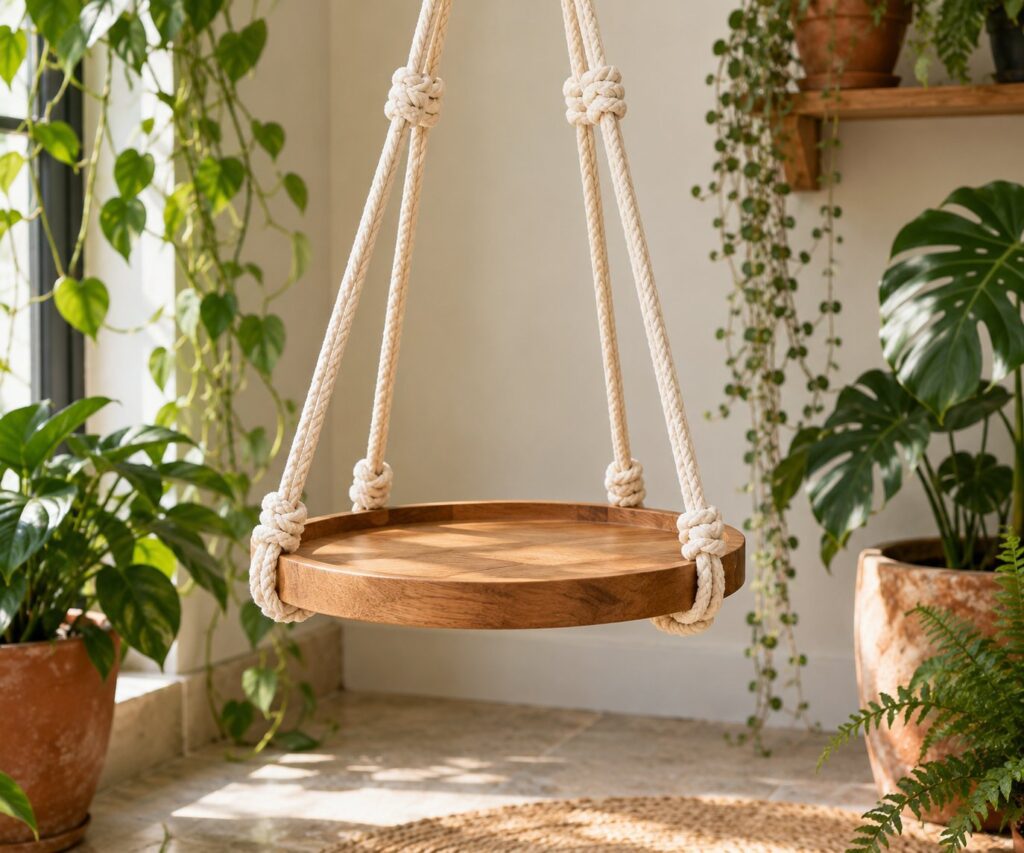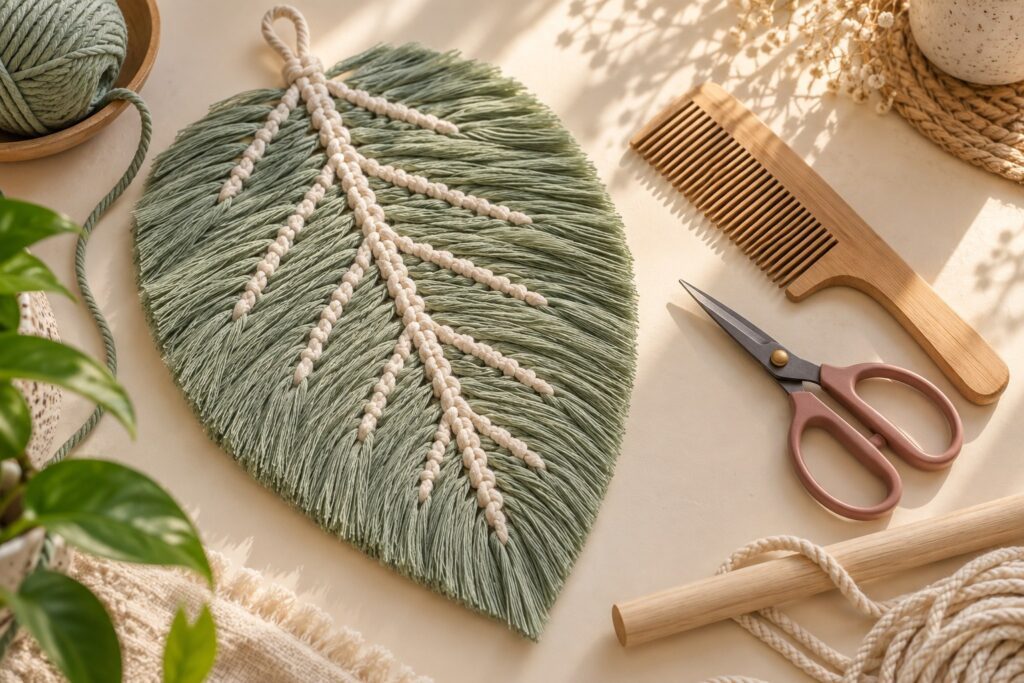

A macramé hanging shelf combines a rigid board with flexible supports. The difficult part is usually not tying the knots: it is keeping four supports the same length and choosing a fixing that suits the wall. Start with a small decorative shelf and work out those details before cutting a full spool of cord.
Choose the board before the knot pattern
Measure the board’s width, depth and thickness. Mark a centerline and four symmetrical corner positions on a paper template. Place that template over the board and check that each hole leaves enough sound timber around it. Have a woodworker determine appropriate hole positions and diameter if the board is thin, split or unfamiliar.
A shallow board reduces the distance between the front and back supports. A very deep board can tip as you move an object away from its center. Avoid warped timber, sharp hole edges and decorative boards with unknown strength. Smooth every surface that touches the cord.

Make a cord plan you can actually measure
- Use the same cord type and diameter for all four support groups.
- Decide whether the supports will be plain, square-knotted or spiral-knotted.
- Make one small sample of the chosen knot sequence; measure how much cord it consumes.
- Include the suspension section, board thickness, securing knots, decorative tail and working allowance in your cutting plan.
For a spiral section, repeat the same half knot. For a flat section, complete the mirrored halves of a square knot. Learn these in the beginner macramé knot guide before assembling a shelf. A spiral and a flat sinnet consume different amounts of cord; counting identical knots is more reliable than copying another project’s cord length.
Build and level on a supported surface
- Lay out four groups. Label front left, front right, back left and back right with removable tape. Keep a written knot count for each.
- Work to a common reference. Suspend the top ring temporarily at a comfortable height and mark the intended board position on a backing board. Do not use this temporary setup as the permanent fixing.
- Support the shelf. Place the board on a stable table while feeding the cords through the smooth holes. Establish the under-board knots or stops specified by your chosen design.
- Check all four corners. Measure from the suspension reference to the board, then use a spirit level front-to-back and side-to-side. Adjust before trimming.
- Choose the installation separately. The hook, anchor, wall or ceiling substrate and attachment method must suit the intended use. Ask a qualified installer if the substrate or load requirements are uncertain.
Fix the problem you can see
| What you notice | What to check first |
|---|---|
| One corner sits low | Compare that support’s knot count and the position of its under-board stop. |
| The shelf twists | Check crossed supports and whether the top attachment lets the whole assembly rotate. |
| A cord rubs a hole edge | Stop using the shelf; smooth or redesign that contact point before continuing. |
| The fixing moves | Take the display down. Do not compensate by tightening decorative knots. |
Keep the finished display simple
Use restrained styling, place items near the center and keep the shelf away from beds, seating and routes where it could be knocked. Inspect wear, slippage and fixings periodically. Do not hang it above a cot or use it to store valuable, breakable or heavy objects.
Next, practice a double half hitch border on a separate sample. It can add detail to a future design without making the support system harder to understand.
Installation reference: Fischer’s fixing safety guidance explains why substrate, correct installation and stated test conditions matter.
Further reading
The project theme in this article is drawn from Macramé for Beginners and Beyond by Amy Mullins and Marnia Ryan-Raison. This PintoCreate guide uses new wording, additional planning advice and original generated illustrations. It does not reproduce the book’s diagrams or its full project pattern.